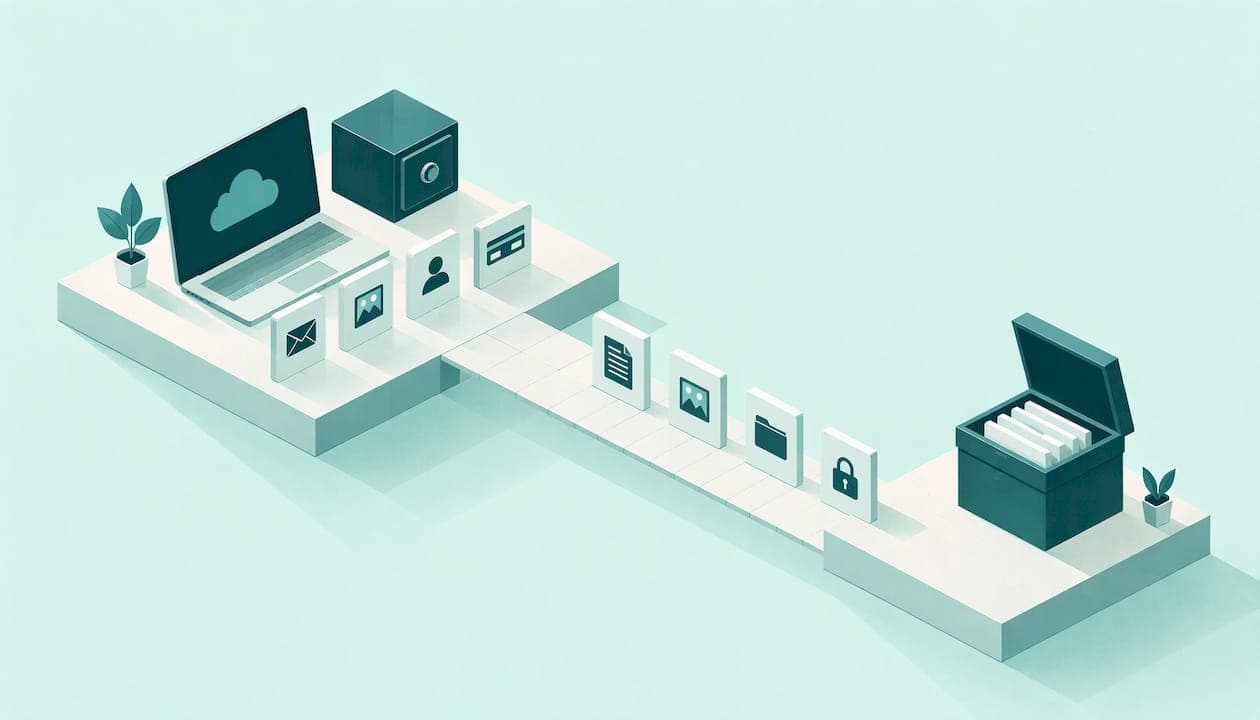
Digital legacy planning means deciding what happens to your online accounts, files, crypto, domain names and subscriptions after you die. Start today by listing your accounts and setting a legacy contact or emergency access on your main email and phone. The ICO and each platform’s help pages explain the rules, and we offer a way to record and update your estate details.
TL;DR:
Inventory primary email and recovery details first, then record crypto key locations, cloud files, domains, subscriptions, and business accounts; review it yearly.
Google’s Inactive Account Manager lets you name up to 10 people to receive selected data after a chosen inactivity period, so select recipients and shared data carefully.
An Apple Legacy Contact needs the setup access key and a death certificate, but cannot access some data, including iCloud Keychain.
Keep legal instructions in your will and operational access details in a separate, updateable record; tell your digital executor where both are stored.
Executors generally need a death certificate and proof of authority; locate crypto keys before seeking specialist advice about transferring assets.
What does your digital legacy include, and why does planning matter?
A digital legacy is the information available about you online after your death, from social media to photos and videos, as the Digital Legacy Association describes it. In practice, you probably hold more of it than you think:
-
Email accounts, which often unlock every other account through password resets
-
Social media profiles and messaging apps
-
Photos and videos in cloud storage or phone backups
-
Cryptocurrency wallets and exchange accounts
-
Domain names, websites and online business accounts
-
Subscriptions, online banking and utility accounts
Without a plan, your family may lose access to important records and irreplaceable photos, and your executor may spend weeks chasing providers. Platform rules and data protection law decide who can get in, so your wishes alone are not enough. A little preparation now saves a great deal of guesswork later.
How do you build an inventory of your digital accounts?
An inventory is the foundation of everything else. Record each item under clear categories:
-
Primary email addresses and the recovery phone numbers attached to them
-
Social media and messaging accounts
-
Cloud storage and photo libraries
-
Crypto wallets, and where the recovery keys are stored
-
Domain names and website hosting
-
Subscriptions and online financial accounts
-
Business or client access, if you work for yourself
For every entry, note the account name, username, recovery email or phone, where the access details are kept, and whether the account has its own legacy settings. Keep the inventory in a password manager with emergency access, or in an encrypted document that your executor knows how to open. Passwords do not belong in a will. A will becomes a public document after probate, and LastPass security guidance advises against putting them there.
Pro Tip: Store the inventory and the logins separately, so that finding one does not hand over the other.

Which platform legacy tools should you set up?
Several providers let you nominate someone in advance. It is worth taking time to set up each one.
-
Google: Inactive Account Manager lets you choose up to 10 people to receive selected data after a period of inactivity that you set. You decide what is shared.
-
Apple: a Legacy Contact can request access using the access key generated at setup plus a death certificate. Some data, such as iCloud Keychain, stays inaccessible.
-
Microsoft: support guidance explains how families request access to Outlook.com and OneDrive, and which documents are usually asked for.
-
Social media: most networks offer memorialisation, deletion or a nominated legacy contact. Rules differ by provider and change often, so check each help page and record your choice in your inventory.
What do the law and data protection rules say about digital assets?
Three points matter most for your plan.
-
Under UK GDPR, people have rights to data portability and erasure, and the ICO explains how these work. Executors can often exercise them on behalf of someone who has died, and organisations should provide data in a machine-readable format where technically feasible.
-
Some digital assets now have clearer legal footing, which helps with inheritance. The government has said the UK is among the first countries to recognise cryptocurrency as personal property.
-
If you run a business, the ICO notes that a sole trader’s executor becomes responsible for customer personal data and must decide whether to keep or securely destroy it.
Recent law: The Crime and Policing Act 2026 amends powers to extract information from online accounts when investigating a death, so authorised persons can access information reachable through the account of someone who has died.
How do you record your wishes and name a digital executor?
Keep two things apart. Your will carries the legal instructions: who inherits, and who your executor is. A separate set of operational instructions says where the inventory lives and how to reach each account. The second document can be updated freely, which a will cannot.
Tell your digital executor, who can be your ordinary executor or someone more at home with technology, about:
-
Where the inventory is stored and how to open it
-
Any printed access keys, such as your Apple access key, and where they are kept
-
Your contact list of people who should be told, and any wishes for social media accounts
-
Service-specific details, such as which accounts have legacy contacts set
The Digital Legacy Association offers a social media will template that can help you put your wishes on paper.
Pro Tip: Ask your digital executor to confirm they know where everything is. A plan nobody can find does not help anyone.
What is a practical checklist for preparing your digital legacy today?
Work through these in one session:
-
Create a simple inventory of your main accounts, starting with email.
-
Set recovery options and add legacy contacts on Google, Apple and any other platform that offers them.
-
Turn on emergency access in your password manager.
-
Print any access keys you need and store them somewhere secure.
-
Tell your digital executor where the inventory is kept.
-
Check that the contact details on your subscriptions and domain names are current.
-
Put a reminder in your diary to review everything once a year and after big life events such as a move, a marriage or a new business.
What do executors and loved ones need to do after a death?
Providers differ, so expect to prove two things: that the person has died and that you are entitled to act.
-
Have a death certificate to hand, and your grant of probate or other proof of your role as executor. Each platform sets its own requirements.
-
When asking an organisation for data or for an account to be closed, use the ICO’s guidance on data portability to frame your request.
-
For crypto, first locate the keys or wallet details, then check the legal position before moving anything. Take specialist probate or legal advice where the sums or the technical risk are significant. Our executors page sets out practical help for the people left to act.
Why does a will paired with a live estate record help executors?
In my experience of will writing, the delays families face rarely come from a dispute. They come from not knowing what exists and where it is. A will tells your executor what to do, but an up-to-date record tells them what there is to deal with. That is why we built the Connected Estate feature: it keeps your estate details current, so your executor starts with information instead of a search.
— Jason
How can we help you create a will and keep a connected estate record?
We let you create a legally valid will for free through a step-by-step guide, in plain English. You can then add the Will + Connected estate option at £9.99 per month, which keeps your property, accounts, digital assets and logins recorded in one place, with live Inheritance Tax estimates. That gives your inventory a home and your executor a clear route in, without paper files or shared passwords. If an estate has no active plan, executors can get connected estate access for a one-off £200, as set out on our executors page.

Ready to begin? Create your will and connected estate on WillFull today.
This article is general information, not a substitute for advice from a qualified lawyer. Consult a qualified legal professional about your own circumstances before acting on anything here.

FAQ
What is digital legacy planning?
Digital legacy planning is organising your online accounts, files and digital property so that the right people can find and manage them after your death. It involves an inventory, platform legacy settings and written instructions for a digital executor. It sits alongside your will rather than replacing it.
What does “digital legacy” mean?
Your digital legacy is the digital information about you that remains after you die. The Digital Legacy Association includes social media, photos, videos, gaming profiles and content created by others in the definition.
What happens to digital assets after someone dies?
It depends on the asset and the provider. Some platforms allow a nominated contact to request access, while others need proof of death and of the executor’s authority. Crypto can pass as property, but only if the keys can be found, which is why an inventory matters.
What does legacy planning mean?
Legacy planning means deciding in advance how your property, belongings and wishes will be handled after your death. It usually covers a will, an executor and a record of what you own. Digital legacy planning applies the same thinking to your online life.